One of the places that we've always wanted to visit is Boston, Massachusetts, so we left Vermont, drove across New Hampshire and the southern end of Maine, and drove into Boston. Boston has so much early American history pre-dating the Revolutionary war and, of course, the Revolutionary war happened all around Boston. So Boston has been high on our bucket list for a long time.
The reality is that Boston is a very overwhelming and head exploding experience. We've driven in Washington D.C. several times and knew that these older east coast cities usually have tight, narrow streets (because they were built for horses, buggies, and foot traffic) and very little available parking. Boston is no exception. Not only are the streets narrow, but there isn't always much sense to the way they are laid out. Again, probably because they are so old and were made for different people in different times and circumstances.
And to add to the crazy streets, Bostonians have an aggressive way of driving -- that's the nicest word we can think of to describe the driving style in Boston. Certainly, their car horns all work; we know this because they use them all the time. We're not entirely sure why there aren't more accidents on the road because drivers don't seem concerned with whether or not a car is already occupying the lane that another driver wants. We've seen several drivers start moving into a lane, just expecting that those cars will make room for them.
We've also been a little disappointed in the way Massachusetts displays their historical sites. Most places we have visited have signs and clearly mark their sites and visitors center. That has not been our experience in Massachusetts. We went to downtown Boston to find the historic section. Fortunately, we had come prepared with a map of historic sites because there were no clear signs to point us in the right direction. We were able to find a parking lot that offered parking for a price. People actually live in downtown Boston and any street parking is reserved for them.
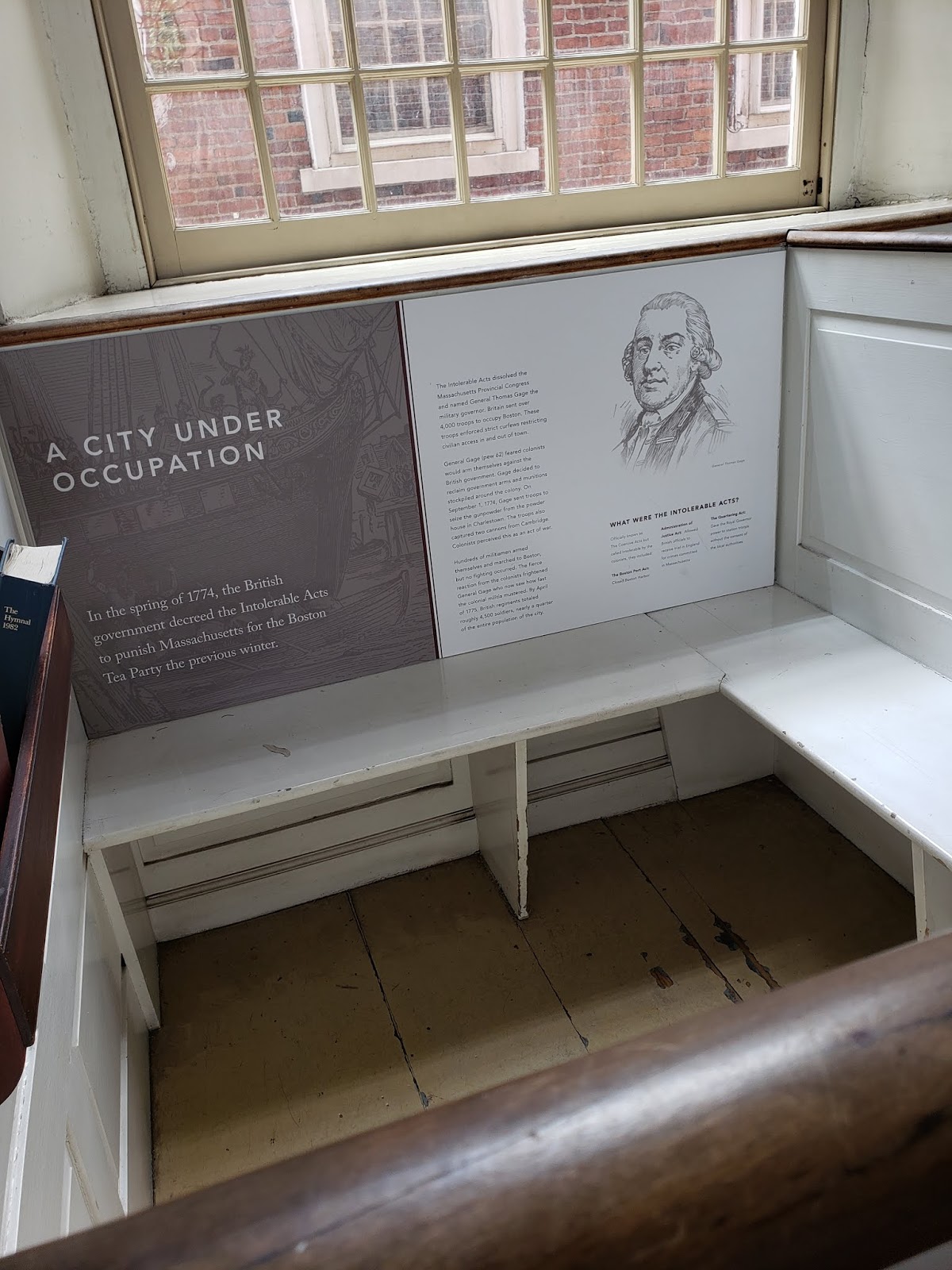
Our first stop was at the Old North Church where the "one if by land two if by sea" lanterns were hung. The young woman, Thalia, who was our tour guide was knowledgeable, friendly, funny, and charming. She allowed the two of us to sit in one of the old pews while she shared the history of the "midnight ride" and answered our questions.
Instead of trying to remember everything the guide told us, the following comes directly from the Old North Church's website regarding the events of April 18, 1775. https://oldnorth.com/historic-site/the-events-of-april-18-1775/
"Boston was under British occupation by an army of 4,500 troops, under the direction of General Thomas Gage, the military governor of Massachusetts Bay Colony. Tensions between the colonists and the soldiers had reached an all-time high. For months, Gage had been sending troops into the countryside to search for and capture arms and ammunition being stockpiled by the colonists. One particularly large stockpile was held in a town called Concord some 20 miles northwest of Boston. Gage decided to send out two regiments, roughly 700 men, to march out to Concord, capture the ammunition and end all hopes of an armed conflict.
"Unfortunately for General Gage, like every time before, his secret plans were discovered by the patriot spy group known as the Sons of Liberty, who quickly hatched their own plan to counteract. They would send their two best riders ahead of the British army, William Dawes and Paul Revere. Dawes and Revere were not to ride all the way to Concord, where the British were headed, but to stop halfway in the town of Lexington. There they were to warn the two leaders of the rebellion, John Hancock and Samuel Adams. But Revere and Dawes were just two men and the fear of being caught was great. With military occupation came military curfews, which restricted when people could leave their homes. So Paul Revere devised a backup plan to make sure his message would leave Boston even if he could not.
"Revere enlisted the help of over thirty additional riders. He placed them across the river in Charlestown and ordered the militia leaders to look to the steeple of Old North Church every night for signal lanterns, the number of which indicating when the British army was leaving Boston and by which route. One lit lantern meant the British would march over the Boston Neck, a narrow strip of land and the only road connecting the town to the mainland, which would take a considerable amount of time. Two lit lanterns in the steeple meant the British would take a shortcut by rowing boats across the Charles River into Cambridge, cutting valuable time off their journey. That’s where we get the famous line from Longfellow’s poem, “One if by land, two if by sea.”
"When the British Navy put boats in the water on the night of April 18, 1775, the colonists knew which way they intended to leave. Paul Revere had two men come to the church that night. One was the sexton, or the church caretaker, Robert Newman. The other was a vestryman of the church and a close friend of Revere’s, named Captain John Pulling Jr. The two men came inside the church’s front door, locking it behind them and then climbed up either one of the staircases in the back corners. Once in the gallery, they squeezed behind the pipe organ and through a small door into the tower. They climbed a winding series of stairs and ladders eight stories high in total darkness. Once at the top, using flint and steel, they lit the two lanterns and held them out the window facing towards Charlestown for just sixty seconds. It doesn’t sound like a long time but it was all the time that was needed.
"When Paul Revere arrived in Charlestown nearly an hour later, he was told that the lights had been seen and men were already riding. He borrowed a horse and began his own ride from there. The message would spread as far north as New Hampshire and as far south as Connecticut. So the next morning on April 19, 1775, when the 700 British troops arrived in Lexington, they did not find the sleeping village they had hoped, instead they found an armed and waiting militia. The shots that were fired that morning became the first of the American Revolutionary War. So here, from General Thomas Gage’s own church, the King’s own church, the lanterns which ignited the American Revolution, were shone ever so brightly."
The Old North Church is still an active church with a congregation of about 120 parishioners. Edie asked the guide if they all lived locally since there is no church parking lot and no street parking available. They would have to walk to church. The guide said that many of them are local, but a few drive in to town for church and the church has a deal with a local parking garage that parishioners can park on Sunday for $3.00.😬
There is a school in the midst of this historic downtown area where the playground is in an alley by the school and the Old North Church.
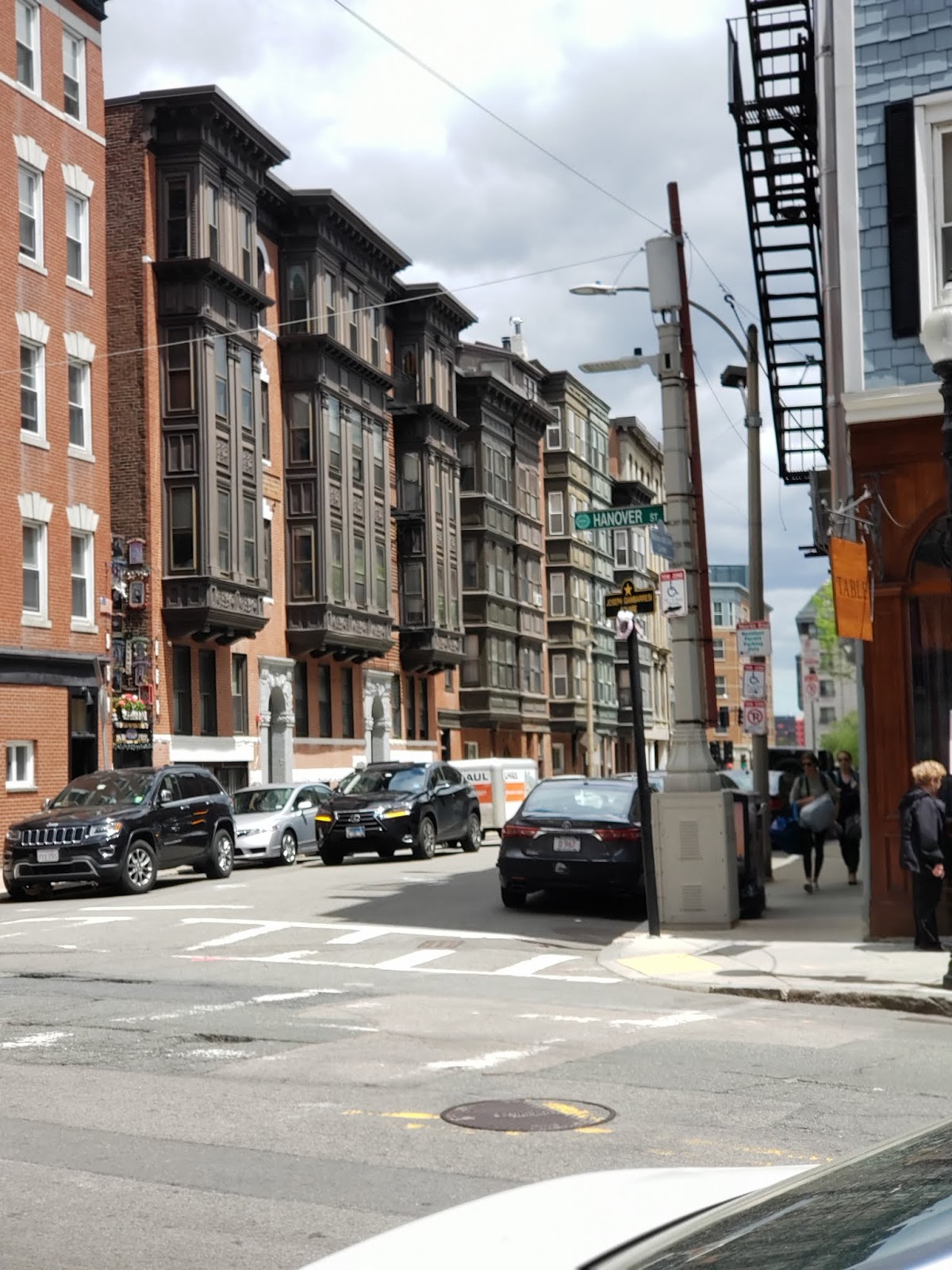
We were also surprised to see that people live in this area in apartments or condos of some kind. Their front doors just open out on to the public sidewalk and they are given a spot on the narrow street to park.
After we left the Old North Church, we stopped for lunch at one of the many restaurants that line the street. The place was called Ben Cotto and mainly served Italian food, but we were able to get salads; chicken for Edie (because Edie doesn't eat seafood 😣) and shrimp for Sandy. Sandy said that she is now ruined for west coast shrimp after eating that salad. The shrimp were big and plump and probably local.
The map we had showed that we were in the vicinity of Paul Revere's home, but we never did find it even though we walked up and down streets and stood in the exact spot the map showed the home. Signs, markings, plaques on the walls... anything... to help people find the historical sites would be fantastic. We ended up only being able to find the Old North Church. In most historical places we visit, there is a designated area where the historical sites are separated from the current living and business establishments. Not so with Boston. They are all intermingled and while tourists are trying to find the historically significant places, regular Bostonians are working, eating, and living. It made for a chaotic and frustrating sightseeing day. But we do have pictures so enjoy.


Newman and Pulling allegedly escaped from the British through this window after hanging the two lamps in the top of the church.

These are people's homes and their parking spots.